Lawn Care Calendar for Warm-Season Grass
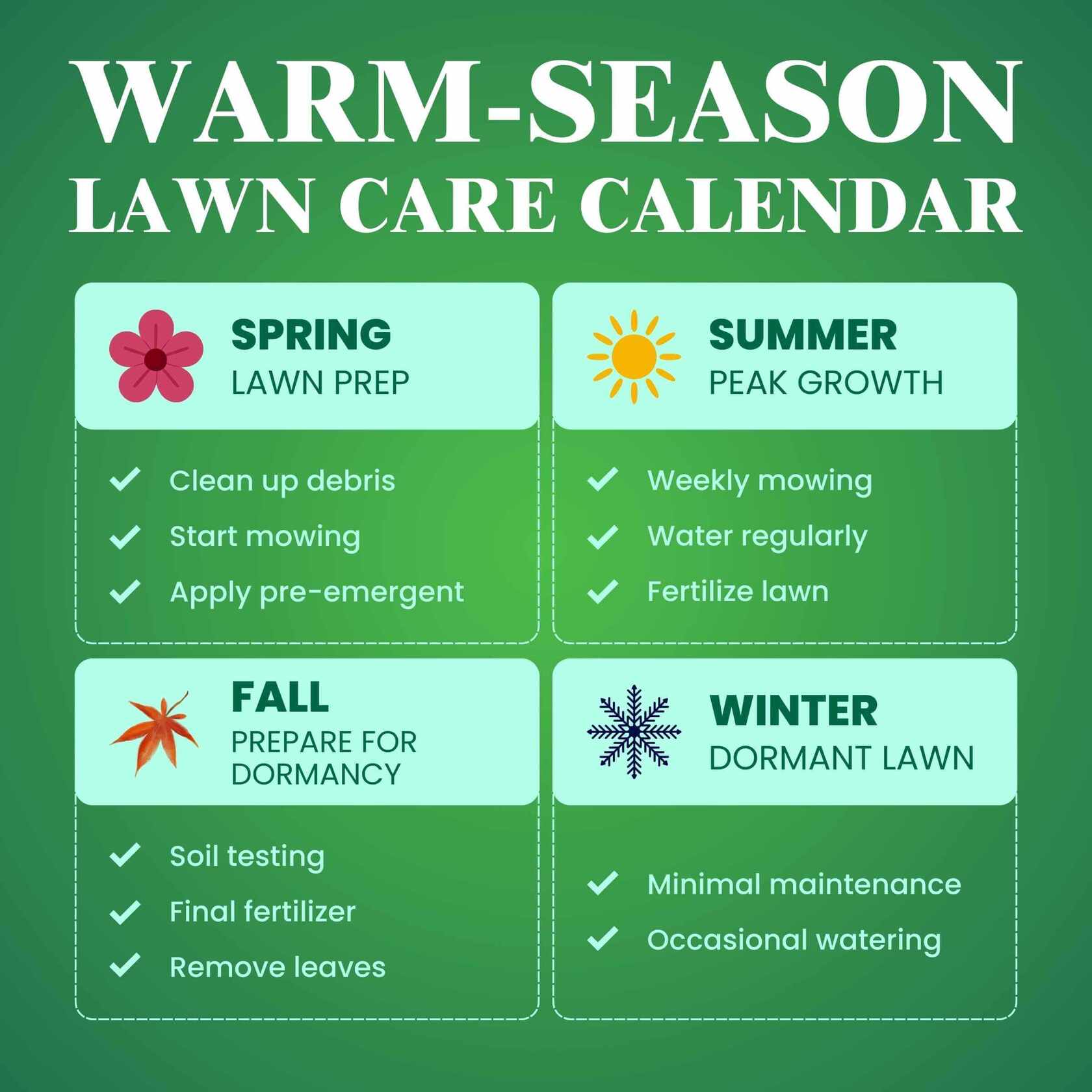
Warm-season grasses thrive in warm weather, so prepare for the bulk of your yard chores to occur late spring through early fall. This lawn calendar for warm-season grass walks you through essential lawn maintenance tasks season by season so you know exactly what to do year-round.
Loaded up on sunscreen? The lawn needs weekly mowing during its most active growth period. Or, save yourself the hassle and hire a local lawn mowing pro instead.
The seasonal lawn care calendar below summarizes the essential maintenance tasks homeowners should follow to keep warm-season grass healthy year-round. Keep in mind that exact timing of these tasks may vary depending on your region.
Warm-Season Lawn Care Calendar at a Glance |
Seasonal Timing |
Lawn Care Task |
Early Spring |
Clean up debris
Rake matted turf
Apply pre-emergent herbicide
Provide supplemental water if needed
|
Mid- to Late Spring |
Begin mowing once the grass is actively growing
Provide supplemental water if needed
|
Late Spring to Early Summer |
Dethatch, aerate, and overseed if needed
Apply fertilizer based on soil test results
Irrigate weekly as needed
|
Summer |
Continue to apply fertilizer depending on soil test results
Irrigate weekly as needed
Maintain a regular mowing schedule
Monitor for pests and lawn disease
Spot-treat weeds with post-emergent herbicide
|
Early Fall |
Apply final fertilizer application if recommended by soil test
Provide supplemental water if needed
|
Early to Mid-Fall |
Test soil, if needed
Apply soil amendments
Apply pre-emergent herbicide
Provide supplemental water if needed
Remove leaves
|
Mid- to Late Fall |
Gradually lower mowing height for the final mow before winter dormancy
Perform the last mow of the season
Provide supplemental water if needed
Remove leaves
|
Winter |
If winter is dry, provide supplemental water every 3 to 4 weeks |
Timing may vary slightly depending on climate zone and local weather conditions. Common warm-season grasses include bermudagrass, zoysiagrass, buffalograss, centipedegrass, St. Augustinegrass, and bahiagrass, which are widely grown throughout the southern United States.
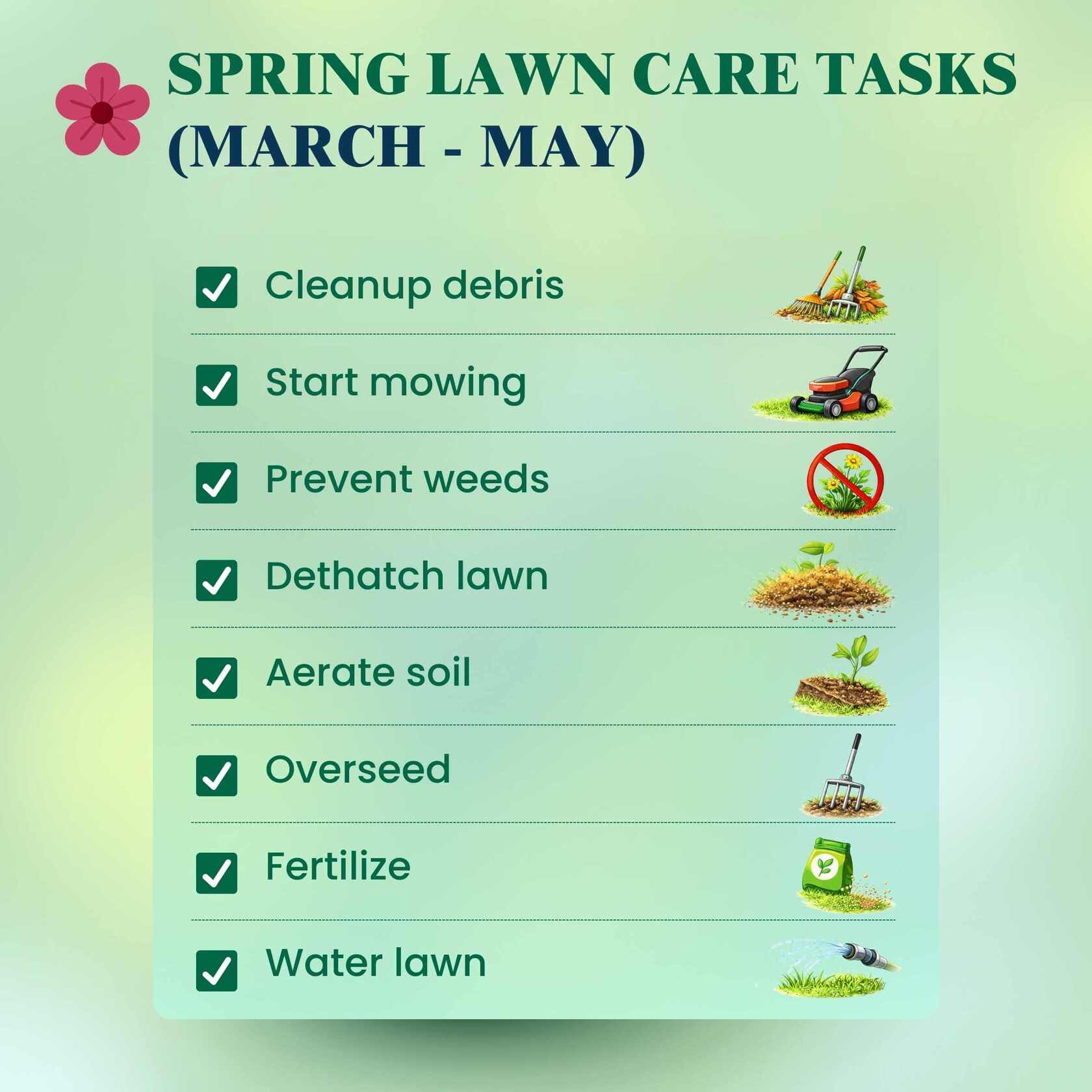
Spring: March, April, May
Remove Winter Debris
As your lawn wakes up from its winter slumber, start with a spring cleanup. Remove debris like branches and twigs that can block sunlight and encourage pests and disease.
Next, gently comb the grass with a rake to gather any small remaining debris. Raking also helps to break up matted grass, increase air circulation and sun exposure, and break down any snow mold that developed over winter.
Mow New Growth
As temperatures start to rise, warm-season grass begins to green up and grow. Bring out the lawn mower and follow these lawn mowing best practices:
The rule of one-third: Do not remove more than one-third of the grass blade’s height in a single cut.
Mow dry grass: Mowing wet grass results in an uneven cut, clumps grass clippings, clogs the mower, and dulls the blades.
Adjust the mowing height: Different grass types have different recommended mowing heights. For instance, zoysiagrass thrives best at 1 to 2 inches, whereas buffalograss prefers 2 to 3 inches.
Sharpen mower blades: Dull mower blades rip and tear grass, resulting in an uneven cut and damaged turf.
Change direction: Vary your mowing pattern each time you cut to ensure grass doesn’t lean in one direction.
Prepare to mow once or twice per week, or hire a lawn care pro for the job.
Apply Pre-Emergent Herbicide
Healthy lawns typically don’t have weed problems. But sometimes you need reinforcements.
If your lawn struggles with weeds, like crabgrass and dandelions, apply pre-emergent herbicides when soil temperatures are 50 to 55 degrees Fahrenheit for several consecutive days.
Note: Do not plant grass seed at this time. Wait at least 12 weeks before overseeding.
Remove Thatch
What is thatch? Thatch is the layer of dead and living organic material that collects between the grass blades and the soil’s surface.
Why remove thatch? A thick layer of thatch can block the soil from accessing fertilizer, water, sunlight, and oxygen. It also makes attractive real estate for pests and fungi to hide in.
How often to remove thatch? Every lawn is different, with some requiring more frequent thatch removal than others. Some lawns may require dethatching every year under heavy thatch buildup, while other lawns may only need dethatching every 2 to 5 years.
When to remove thatch? Remove thatch when the layer exceeds one-half inch thick. The best time of year to dethatch warm-season grass is late spring or early summer.
Tip: Dethatch the lawn before aeration and fertilization.
Aerate Soil
What is aeration? Aeration is the process of removing plugs of soil from the ground to relieve soil compaction.
Why aerate soil? Dense, compacted soil prevents grass roots from accessing nutrients, water, and oxygen.
How often to aerate? It depends on your lawn’s soil type. Lawns with clay soil often require annual aeration, while sandy soils typically need aeration every 1 to 3 years.
How to test soil compaction? Perform the screwdriver test. If pushing a 4 to 6 inch screwdriver into moist soil is difficult, then the soil is likely compacted and requires aeration.
When to aerate? The best time to aerate warm-season lawns is in late spring or early summer.
Tip: Aeration is a great treatment to perform before overseeding and fertilization, because it improves seed-to-soil contact.
Overseed
Overseeding is the process of spreading new grass seed over an existing lawn. If your lawn is thinning or has bare patches, overseeding can help encourage new growth and thicken turf.
The best time to overseed warm-season grass is late spring to early summer.
To ensure your new grass has the best chance for success, wait 4 to 6 weeks before applying a nitrogen-heavy fertilizer.
Learn How to Aerate and Overseed Your Lawn in 5 Simple Steps.
Fertilize
Before you feed your lawn fertilizer, test your soil. Fall is the best time to test soil, but it’s not too late to test your soil in spring.
Results from a laboratory soil test (typically performed at your local cooperative extension) often include comprehensive instructions on how much fertilizer your lawn needs, when to apply it, and how often to apply it.
Start your fertilizer regime when the grass is actively growing. Warm-season grasses begin actively growing when soil temperatures consistently reach about 65 degrees Fahrenheit, typically when daytime air temperatures range between 75 and 95 degrees Fahrenheit.
Remember: Wait 4 to 6 weeks before applying nitrogen-heavy fertilizer to new grass seed.
To learn more about fertilizer, check out the following guides:
Water (If Needed)
Most warm-season lawns require 1 inch of water every week, including rainfall. Spring showers can help with the job, but if it’s a particularly dry season, you may need to provide supplemental water.
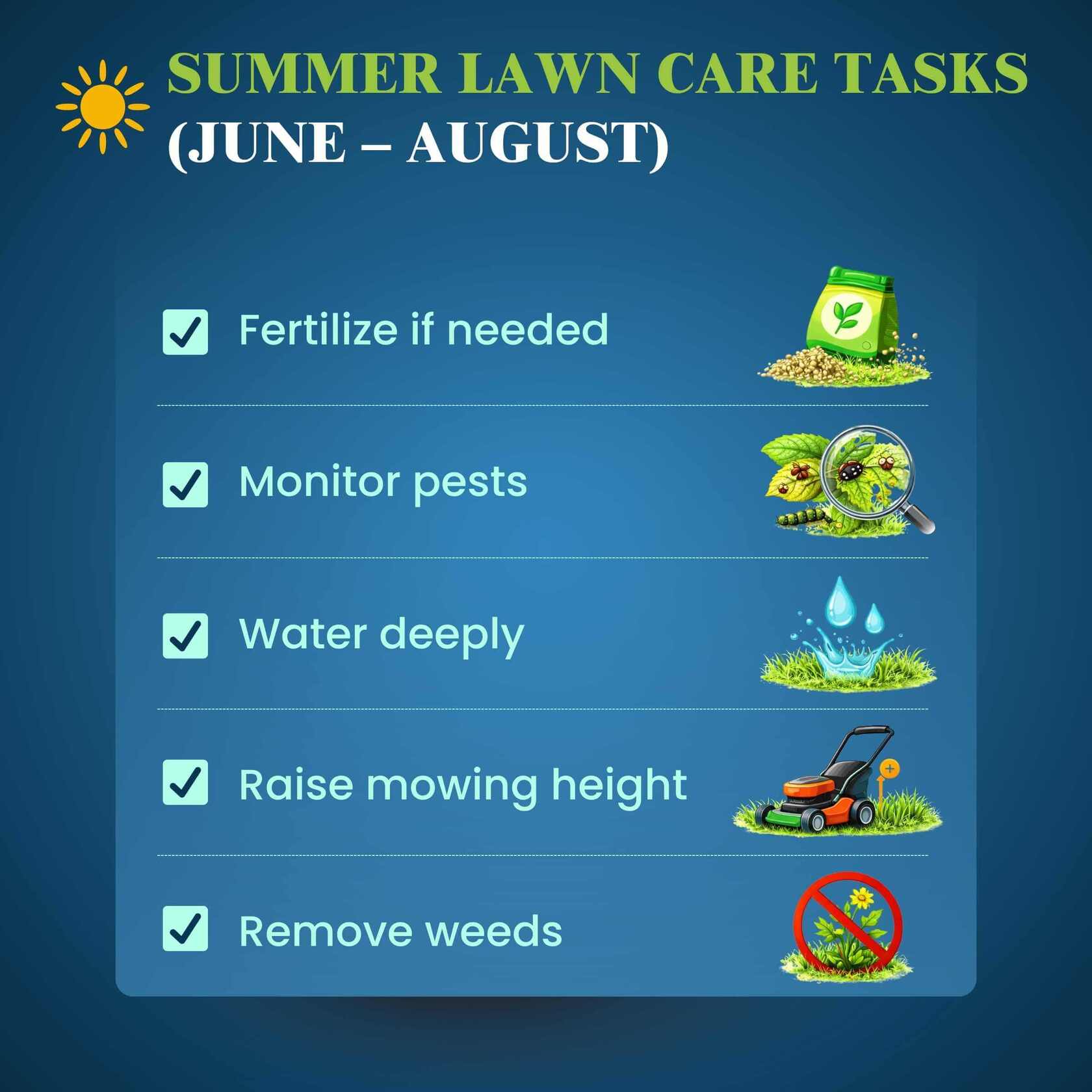
Summer: June, July, August
If you didn’t dethatch, aerate, and overseed your warm-season grass in late spring, early summer is the time to complete those tasks.
Fertilize
If your soil test calls for additional fertilizer, continue fertilizing throughout summer every 4 to 6 weeks.
Manage Pests and Disease
Lawns can become a breeding ground for pests and lawn disease, especially in summer when temperatures and humidity are high.
Monitor your lawn throughout the season for any signs of an infestation.
Tip: The best way to prevent pests and fungi in the lawn is to keep your yard well maintained. Practice good mowing, fertilization, and irrigation practices before turning to pesticides or fungicides.
Water Regularly
Keep your lawn well watered throughout summer, especially during drought and high heat.
Not only does water quench your lawn’s thirst, the right irrigation technique helps to develop a deep and strong root system. The key is to water infrequently for long periods (about 1 to 3 times per week) instead of frequently for short periods.
Water your lawn before 10 a.m. to avoid water loss from evaporation. Avoid watering in the evenings — the grass won’t dry completely, and the moisture may attract pests and lawn disease.
Raise Mowing Height
Mowing at the higher end of your grass type’s recommended height helps protect your lawn from heat stress, drought, and weeds in summer. The taller blades reduce water evaporation by shading the soil and cooling the grass roots.
Remove Weeds
Are dandelion puffs peppering the lawn? Remove summer weeds with a post-emergent herbicide.
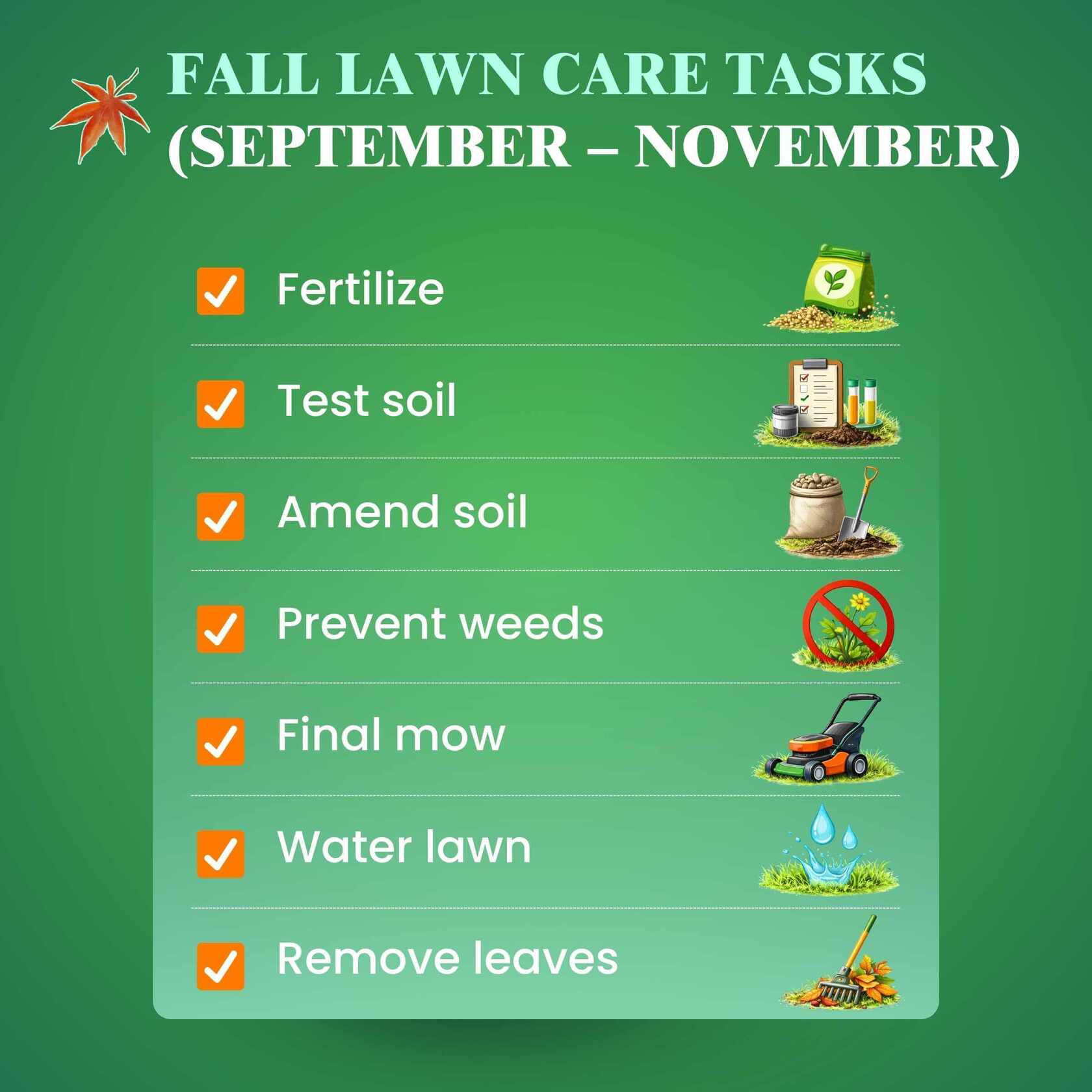
Fall: September, October, November
Fertilize
Your soil test results may recommend one final fertilizer application in mid-August to early-September.
Perform this last application no later than 6 weeks prior to your region’s average first frost date. Otherwise, your warm-season turf becomes susceptible to winter damage.
Test Soil
Fall is the best time to test your soil. To learn the most about your soil and receive comprehensive instructions on how to maintain your lawn throughout the year, send a soil sample to your local cooperative extension for laboratory testing.
A soil test can reveal the following traits about your soil:
Soil type (clay, sandy, loamy, or silt)
pH level (alkaline or acidic)
Nutrient deficiencies
Organic matter levels
Tip: Test your soil every 3 to 5 years.
Apply Soil Amendments
A soil test may reveal that your soil needs amendments. Different from fertilizer, which feeds your grass, soil amendments adjust your lawn’s structure, texture, and pH.
For example, lime raises soil pH, making it more alkaline and less acidic. Apply sulfur to lower the soil pH, making it less alkaline and more acidic.
When the soil’s pH is too high or too low, grass roots struggle to absorb nutrients efficiently. It can take months for soil amendments to take effect, so refer to your soil test results to determine when to resume any fertilization.
Apply Pre-Emergent Herbicide
If your lawn suffers from winter weeds, like chickweed and henbit, apply pre-emergent herbicide to prevent winter annual weeds from germinating. Apply when soil temperatures drop below 70 degrees Fahrenheit but before they reach 55 degrees.
Warm-season grasses slow down growth as fall temperatures drop.
Gradually lower the mowing height to the low end of your grass type’s recommended range for the final mow before winter. If grass enters winter too tall, it becomes more susceptible to matting, winter damage, and snow mold.
Continue to Water
In many regions of the U.S., fall rainfall provides enough water for the lawn. However, if precipitation is low, provide supplemental irrigation until the lawn receives its recommended 1 inch of water per week.
Remove Leaves
Autumn’s colorful fallen leaves may look beautiful on the yard, but a thick layer of leaves can block sunlight and suffocate your grass. And if it’s a particularly rainy season, the wet leaves may invite pests and fungi.
Bring out the rake, leaf blower, or leaf mulcher and expose your grass to some much-needed sunshine and oxygen.
Not sure how to start? Here’s What You Should Do With Fall Leaves.
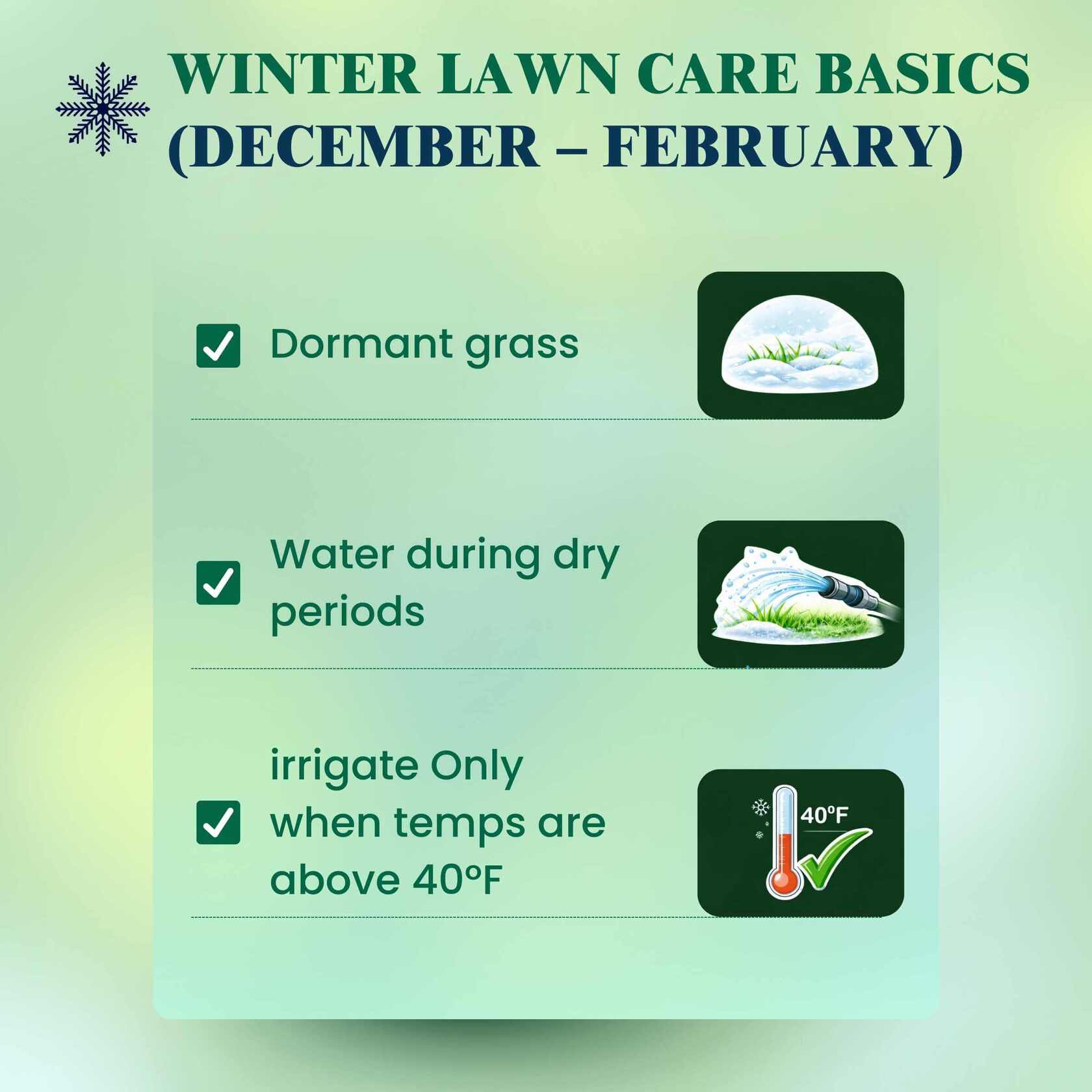
Winter: December, January, February
Winter is the slowest time of year for lawn maintenance. Warm-season grass enters dormancy, and requires little maintenance beyond occasional supplemental irrigation.
If winter is unusually dry, water the lawn with 0.25 to 0.5 inches of water every three to four weeks when air temperatures are above 40 degrees Fahrenheit and the ground isn’t frozen. This won’t green up the lawn, but it will help keep the grass alive.
Hire a Lawn Care Professional With GreenPal
Your warm-season grass requires the most care during the hottest months of the year. While many of these chores are only necessary every few years, weekly mowing is a non-negotiable.
Weekly mowing during peak growing season can be time-consuming. Many homeowners choose to hire a local lawn mowing professional to keep their yard looking consistent all summer.